
The Anatomy of Desk Fatigue in Muscat
In the corporate and professional landscape of Muscat, hours spent seated behind workstations, in traffic, and leaning into digital screens exert unrelenting compressive forces upon the spine.
When you remain seated for more than six hours daily, the hip flexors (particularly the iliopsoas) shorten, pulling the pelvis forward into anterior tilt. This places excessive shear stress upon the L4–L5 and L5–S1 lumbar discs while inhibiting gluteal activation and forcing the mid-back and neck into compensatory hunching. The result is chronic, nagging lower back ache, thoracic stiffness, and shallow breathing.
Why Aggressive Stretching Fails: The Somatic Pandiculation Method
Many people instinctively attempt to resolve tight muscles with vigorous static stretching. However, aggressive stretching often triggers the body's protective stretch reflex (the myotatic reflex), causing muscles to reflexively tighten further to protect joints.
Thomas Hanna's clinical somatics revealed that chronic muscle tightness is not a structural flaw, but a brain habit called Sensory Motor Amnesia.
Somatic yoga resolves this through pandiculation—a three-stage neuromuscular re-education process: 1. Conscious, gentle voluntary contraction of the tight muscle group. 2. Extremely slow, controlled lengthening under active awareness. 3. Complete, conscious relaxation to reset baseline resting muscle tone.
3 Essential Somatic Movements to Decompress the Lumbar Spine
These gentle floor-based movements can be practiced at home in Muscat without requiring extreme flexibility:
- The Somatic Arch & Flatten: Lying supine with knees bent, gently arch your lower back on an inhale, tilting the tailbone downward. On the exhale, slowly press the lumbar spine flat against the mat, engaging the lower abdominals. Repeat 8 times with microscopic slowness.
- Side-Lying Waist Pandiculation: Releasing the quadratus lumborum (the deep flank muscle often responsible for unilateral back spasms) through gentle oblique contraction and gradual release.
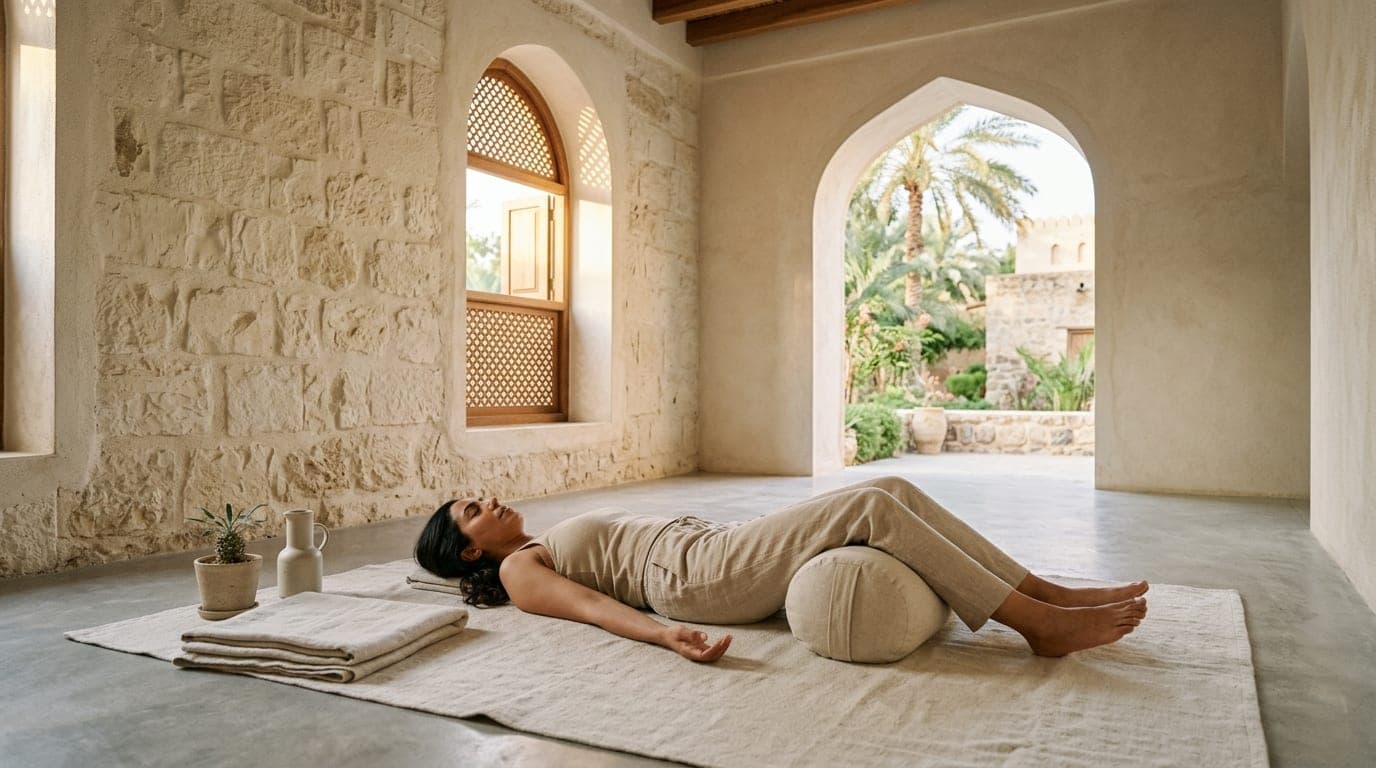
- Psoas Release with Constructive Rest: Resting with knees elevated on a bolster for 10 minutes to allow deep pelvic fascia to soften without mechanical tension.
Integrating Nervous System Calming with Physical Realignment
Physical back pain cannot be separated from autonomic nervous system stress. When workplace demands elevate sympathetic arousal, muscle tone naturally stiffens across the spinal erectors as an ancient defensive armor.
In private sessions at Journey with Nawal, somatic movement is paired with gentle diaphragmatic breath coaching and acoustic grounding to down-regulate nervous system vigilance, allowing deep tissue restoration that lasts far beyond the session. Explore our holistic wellness services in Oman or get in touch for private movement sessions. Peer-reviewed clinical studies in physical rehabilitation validate that somatic neuromuscular re-education significantly outperforms passive rest for chronic lumbar discomfort.


